
Protect Critical Infrastructure With Removable Flood Wall Barriers Engineered for FEMA & USACE Compliance. Custom, U.S.-Made Solutions Since 1997.
For over 27 years, Flood Control America has engineered removable flood wall barriers for communities, businesses, and government agencies nationwide. Our systems integrate seamlessly with permanent flood defenses like levees and concrete walls, creating complete protection where it's needed most. Every system is 100% U.S.-made and manufactured to civil-grade specifications.
Effective flood protection depends on more than just the permanent structures. Levees and concrete walls have gaps in the sections that can't accommodate barriers, like utility crossings, which become devastating weak points. Our removable flood wall barriers solve this challenge with an innovative design. They deploy rapidly when flood threats emerge, create watertight seals across openings, and store compactly between events. From critical infrastructure to urban developments, our solutions are trusted by the U.S. Army Corps of Engineers, municipal planners, and facility managers nationwide.
What Are Flood Wall Barriers?
Flood wall barriers are modular aluminium or stainless-steel planks that lock into pre-installed fixtures. Once assembled, they create a watertight wall that stops floodwater from entering protected areas. They're essentially a modern, engineered alternative to sandbags and other temporary methods, offering a more reliable defense for critical infrastructure. Property owners benefit from their modular design and low-profile installation, which allows for day-to-day access without sacrificing preparedness. Unlike permanent structures, these barriers are installed only when needed and stored away to allow normal access when the threat is over.
Common Use Cases
- Integration with Permanent Defenses: Flood wall barriers connect with existing levees and concrete walls to form a continuous line of defense
- Standalone Perimeter Protection: For facilities in flood-prone areas without permanent barriers, these systems create complete perimeter defense around individual buildings or infrastructure
- Flood Wall Closures: For short-span openings in levees or flood walls (roadways, pedestrian entrances, utility crossings) the removable planks deploy only when needed to close the gap and complete the defense line.
Key Advantages Over Sandbags
Sandbags have served as the default emergency response for decades, but they're known for having significant limitations. They require extensive labor to deploy, can't offer a consistent seal, and often fail under water pressure and hydraulic loads.
Flood Control America's barriers meet engineering standards that sandbags can never match. They install quickly with small crews and provide superior protection through corrosion-resistant aluminum and stainless steel construction. Unlike sandbags, which degrade after a single use and then create disposal problems, flood wall barriers are built for repeated deployment over years.
Differences from Flood Gates or Stop Logs
While flood gates and stop logs serve similar purposes, they're also permanent or semi-permanent solutions that require a significant amount of infrastructure. Our flood wall barriers are fully removable and won't obstruct daily operations when not in use, which makes them adaptable to many types of sites and layouts. Our flagship solution, the Invisible Flood Control Wall (IFCW™) uses discreet ground anchors. It remains completely out of sight during normal conditions but delivers powerful protection when there's a threat.
How Flood Wall Barriers Work
Flood Control America systems are custom-engineered for each site, with fixtures pre-installed to minimize disruption. Once a flood warning is issued, your team installs the lightweight planks and other components to create watertight protection.
- Site Engineering and Layout: We assess your site’s access points, elevations, and tie-in requirements to permanent defenses (levees, concrete walls, structures). The ultimate design takes into account the sill heights, anchor spacing, and opening widths to create one continuous protection line.
- Fixture Installation: Ground sleeves, sills, and anchor points (where required) are installed and finished to stay flush or near-flush with existing surfaces, keeping sidewalks, roads and doors fully usable. We also provide training for your team on barrier storage, staging, and deployment procedures.
- Rapid Deployment: When there’s a flood risk, the components of the walls are moved from storage to pre-planned locations. Crews set posts (where required) and stack the aluminum or stainless steel planks. Integrated seals create tight closures across roads, doorways, and walkways. The barriers can be connected end-to-end or integrated with permanent defenses for unified protection.
- After the Storm: The barriers can be easily taken down, inspected, and stored for the next event. Normal site operations can resume immediately.
For short gaps in levees or flood walls (road crossings, utility corridors, entrances), planks are deployed only when needed to "close the gap."
How Our Flood Barrier Systems Work
Flood Control America systems are custom-engineered for each site, with fixtures pre-installed to minimize disruption. Once a flood warning is issued, your team installs the lightweight planks and other components to create watertight protection.
Removable and Reusable
Designed for quick assembly before a flood with common tools and minimal training, as well as easy removal afterward.
Custom-Fit Design
Each system is engineered around site-specific requirements to integrate with existing levees or permanent structures.
Durable Materials
100% U.S.-made aluminum and stainless steel resist corrosion, abrasion, and environmental exposure, for an exceptionally long service life.
Tested and Approved
Trusted by the U.S. Army Corps of Engineers for critical flood protection projects across the country.
Low Maintenance
Minimal upkeep requirements mean the barriers stay ready for deployment year after year, reducing both time and cost over their lifespan.
Key Features of Our Flood Wall Barriers
Every Flood Control America barrier system is built for civil-grade performance and designed to be practical in real-world conditions. Here's why they stand out:
- Removable and Reusable: Designed for quick assembly before a flood with common tools and minimal training, as well as easy removal afterward.
- Custom-Fit Design: Each system is engineered around site-specific requirements to integrate with existing levees or permanent structures.
- Durable Materials: 100% U.S.-made aluminum and stainless steel resist corrosion, abrasion, and environmental exposure, for an exceptionally long service life.
- Tested and Approved: Trusted by the U.S. Army Corps of Engineers for critical flood protection projects across the country.
- Low Maintenance: Minimal upkeep requirements mean the barriers stay ready for deployment year after year, reducing both time and cost over their lifespan.
Where Our Flood Wall Barriers Are Used
Flood Control America's modular barrier systems are deployed in a wide range of applications, providing reliable protection where it's needed most. They're meant to be adapted to virtually any site layout and meet a wide range of needs.
- Urban and Riverfront Development: Ideal for protecting businesses, homes, and public spaces in flood-prone areas without interrupting normal activity.
- Municipal Buildings and Infrastructure: Protecting essential government buildings and public utilities, as well as road crossings, utility corridors, and access points where it’s not practical to have permanent flood barriers.
- Critical Utilities and Communications Facilities: Safeguarding power plants, water treatment facilities, and telecom sites that have to stay operational during a flood. These facilities especially benefit from systems capable of diverting water efficiently and preventing system-wide flood damage.
- Coastal and Hurricane Zones: Reliable defense for coastal communities or industries against storm surges and tidal flooding.
- Universities, Airports, and Transit Systems: Large campuses and facilities need scalable solutions that cover extensive perimeters while maintaining normal access until protection is required.
Each installation receives site-specific engineering to ensure reliable performance across diverse environments and applications.
Why Choose Flood Control America (Trusted by Cities, Facilities & Fortune 500s)
When floodwaters rise, you need protection that's engineered to perform. For over 27 years, Flood Control America has been the trusted choice for municipalities, Fortune 500 companies, and facilities. Our IFCW™ system meets U.S. Army Corps of Engineers standards, and our track record includes hundreds of successful installations nationwide. Explore our projects to see how we've helped others, and let's design a solution tailored to your site.
- Proven since 1997: Nearly three decades pioneering removable flood barrier technology with installations protecting municipal infrastructure, university campuses, utilities and private facilities across the country.
- American-made quality: All components designed and manufactured domestically to ensure consistent quality and reliable supply chains.
- Engineered Integration: Systems connect end-to-end and tie seamlessly into permanent defenses, eliminating gaps and weak points.
- Industry Leadership: Organizational partner with the Association of State Floodplain Managers (ASFPM), demonstrating our commitment to advancing flood protection standards.
- Standards & compliance: Designs comply with criteria established by US Army Corps of Engineers and the dry floodproofing principles supported by FEMA and the National Flood Insurance Program (NFIP).
Project Spotlights
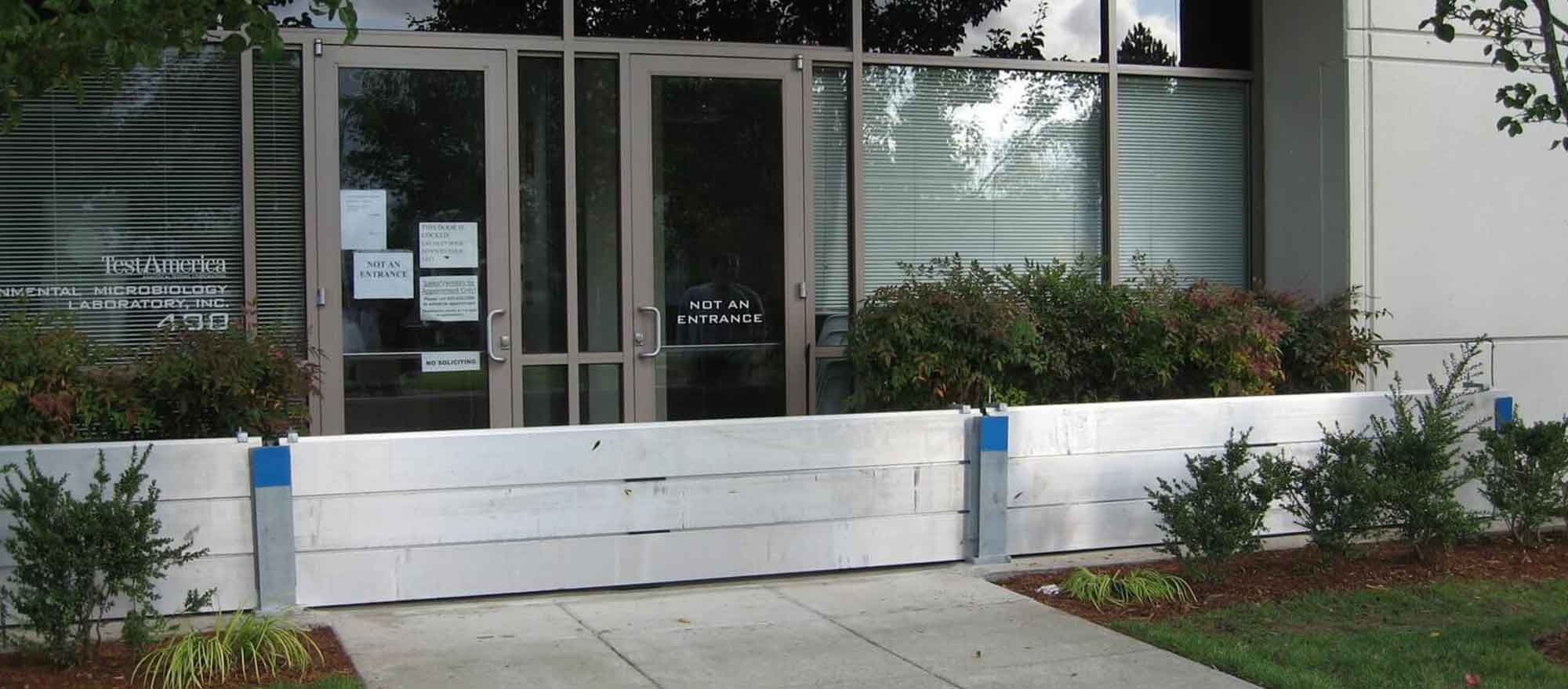
T-Mobile (Pacific Northwest)
A hybrid office/communications site prone to chronic flooding was protected with a perimeter solution using bulkhead channels and 10-foot planks. The solution provides quick closures in tight spaces without disrupting daily operations.
View Project
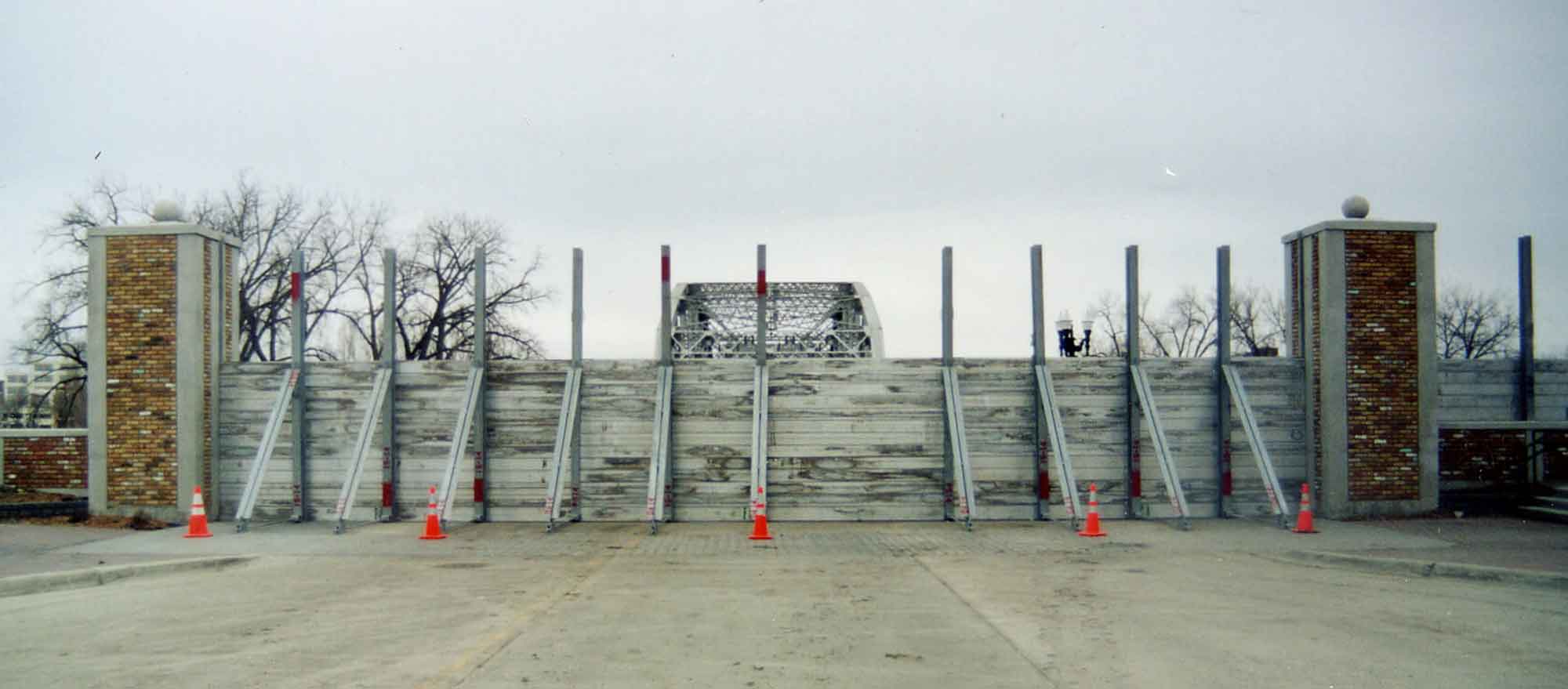
East Grand Forks, MN (Downtown riverfront)
Removable street and rail closures plus an architectural half wall protect the commercial district. Openings stay usable until just before the water is predicted to rise, and then crews can complete the line of defense.
View Project

University of Iowa (Art Building West)
After severe flooding, FCA engineered a removable perimeter wall with custom 90-degree corner posts. The system protects the facility during flood events while maintaining normal access the rest of the year. Additional removable walls now protect other campus locations.
View Projects

140 West, New York, NY
An urban infrastructure project with compact, demountable protection appropriate for dense environments where permanent obstructions aren't feasible.
View Projects
When your goal is complete, civil-grade protection without daily operational disruption, Flood Control America's removable flood wall systems deliver incredible performance. Explore more examples on our projects page or contact us to engineer the right solution for your site.
FAQs
What are flood wall barriers and how do they work?
Flood wall barriers are removable, modular systems made of aluminum or stainless steel planks that install into pre-engineered fixtures. Once assembled, they create a watertight seal that prevents floodwater from entering protected areas. Flood Control America’s systems use pre-installed anchors, posts, compression channels, and integrated gaskets to form a continuous line of defense that can tie into permanent levees or concrete walls.
How do removable flood wall barriers compare to permanent flood protection systems?
Permanent flood walls and levees provide constant protection but require fixed structures that may interfere with daily access. Removable flood wall barriers provide the same civil-grade protection during a flood event while allowing normal operations the rest of the year. They are installed only when needed, making them ideal for roadways, pedestrian entrances, utility crossings, and other openings in permanent defenses.
Are Flood Control America’s barriers compliant with FEMA and USACE regulations?
Flood Control America systems are engineered to comply with criteria established by the U.S. Army Corps of Engineers and follow dry floodproofing principles supported by FEMA and the National Flood Insurance Program. The IFCW™ system has been analyzed and accepted for use by the U.S. Army Corps of Engineers on numerous projects.
What types of properties or sites are best suited for removable flood walls?
Removable flood walls are well suited for municipal infrastructure, riverfront developments, utilities, universities, transportation facilities, coastal sites, and commercial properties located in flood-prone areas. They are especially effective where permanent flood structures have necessary openings that must remain accessible during normal conditions.
What is the difference between a flood wall barrier and a closure?
A flood wall barrier can refer to a full perimeter or long-span system designed to protect a facility or development. A closure typically refers to a shorter removable section that seals a gap in an existing levee or concrete wall, such as a roadway or pedestrian crossing. Both use similar engineered components but are designed for different applications.
How quickly can the flood wall system be deployed before a flood event?
Deployment rates typically range from approximately 100 to 200 square feet per man-hour, depending on the complexity of the installation and site conditions. Systems are designed so small crews can assemble them efficiently once a flood warning is issued.
What kind of maintenance do removable flood barriers require?
Maintenance requirements are minimal. An annual test installation of at least one section of each barrier type is recommended to confirm readiness and proper fit. Components should also be inspected during takedown and storage to ensure seals and hardware remain in good condition.
Can these systems be customized for unique site conditions or structural openings?
Yes. Each Flood Control America system is custom-engineered for the specific site. Designs account for opening widths, sill elevations, tie-ins to permanent structures, and hydraulic loading requirements. Systems can integrate with levees, concrete flood walls, buildings, and other infrastructure.
What are the storage requirements for flood wall components when not in use?
When not deployed, components are disassembled, inspected, and stored in a designated on-site or nearby storage area. Planks, posts, and hardware are designed for compact storage to allow efficient staging and rapid deployment when needed.
How long do flood wall barriers last?
The aluminum and steel structural components do not have a defined shelf life and are designed for long-term durability. Gaskets should be inspected for tears or damage during takedown and storage. With proper inspection and maintenance, systems are built for repeated deployment over many years
Does Flood Control America provide installation or training services?
Flood Control America provides a customized Operations and Maintenance Manual with each system. The team can advise on installation procedures through multiple methods, including in-person support when required.
What is the typical lead time for a new flood wall barrier system?
Engineering calculations and shop drawings are typically completed within 2 to 4 weeks. Embedded elements are generally delivered 4 to 8 weeks after submittal approval. Planks, posts, and hardware are typically ready for shipment 8 to 12 weeks following that phase.
Can the system be integrated with existing levees or concrete flood walls?
Yes. Vertical connections to existing levees and concrete walls can be achieved using post-installed anchors and engineered tie-in details to create a continuous flood protection line.
What kind of warranty or support comes with the system?
A standard one-year warranty is provided. Extended warranty options can be arranged depending on project requirements.